Zeikn

I build software that sits close to the metal — real-time audio, protocol bridges, and client engineering across desktop, browser, and game clients.

Rust, C++, Python, and TypeScript. I've shipped a cross-platform music app, built WebSocket bridges connecting browsers to desktop apps to game engines, and worked across reverse engineering, UI automation, and real-time AI voice pipelines.

Flagship project
Soundie app icon

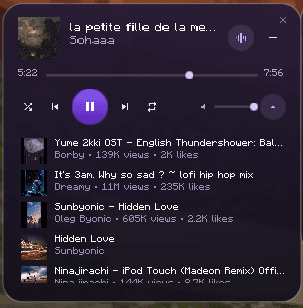
A cross-platform music app spanning desktop, web, and Android — built as a real product, not a demo: a Rust workspace of a dozen-plus crates behind a fast, native player, a public marketing site with real documentation, and a plugin system built for third parties to extend it safely.

Desktop

Rust + Tauri core. Custom audio engine (Symphonia decoding, Rubato resampling, RustFFT), a Tantivy-backed search index over the local library, SQLite via sqlx, and a WASM-sandboxed plugin runtime (Wasmtime) so third-party plugins can't touch the host.

Website

Next.js 15 + React 19 marketing site and docs (API reference, RPC protocol, plugin authoring, theming) at soundie.org, built with Tailwind and Framer Motion.

Android

A companion Android build of the player, sharing the same product surface.

  • Discord Rich Presence and lyrics as sandboxed first-party plugins
  • Credential storage through OS keychains plus AES-GCM, with secrets zeroized on drop
  • A themeable UI with a live in-app theme editor
  • An autoplay/recommendation crate driving what plays next
RustTauriReact 19Next.js 15TypeScriptSQLiteWasmtimeTantivy

Other projects

Protocol bridges, game-client engineering, and real-time systems.

src/opus_encoder.c diff

- static inline float soft_clip(...)

- st->bitrate_bps = 510000; // hardcoded cap

+ st->bitrate_bps = user_bitrate_to_bitrate(...);

patched: silk encoder · celt encoder · opus_defines.h

Modified Opus Codec

Patched libopus internals to push past the reference encoder's limits

A source-level fork of Xiph's reference libopus (1.4), reverse-engineering the encoder internals across both sub-codecs — SILK for speech, CELT for music — to strip out the built-in safety limiters: the hard soft-clipper, saturators, fixed bitrate caps, and bandwidth/sample-rate constraints, rebuilt as a Windows DLL. The point was pushing encoder fidelity further than the reference implementation allows while keeping the bitstream itself decodable by any standard Opus decoder.

CAudio DSPReverse engineeringWindows DLL
YTM Float screenshot

YTM Float

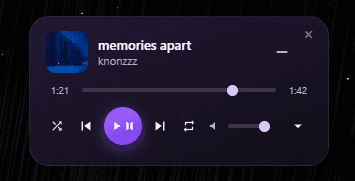
Frameless always-on-top floating player for YouTube Music

A browser extension paired with an Electron companion app. The extension reads YouTube Music's internal player state and queue data straight out of the page; the companion app renders the actual floating, draggable, always-on-top widget — something a browser extension can't do on its own. The two talk over a local WebSocket bridge, entirely on localhost. Ships public installer releases and runs inside Opera GX's sidebar panel.

ElectronChrome Extension APIsWebSocketJavaScript
Jukeraft screenshot

Jukeraft

The same floating widget, rendered live inside Minecraft

A Fabric mod that reproduces the YTM Float / SpotiFloat widget 1:1 in-game, toggled with a keybind, draggable, switchable between providers without a restart. It speaks the exact same WebSocket bridge protocol as the desktop companion apps — connecting to one if it's running, or hosting an embedded server itself if not. Later versions added a direct-connection mode with in-game search and taste-based autoplay, no companion app required. The rounded-corner UI is drawn with a custom GLSL core shader computing a per-pixel signed-distance-field rectangle, avoiding vanilla Minecraft's blocky nine-slice textures entirely. Published on CurseForge.

JavaFabricMixinGLSLWebSocket
voice pipeline

[VAD] speech detected — user: Zeikn

[STT] "hey nova, what's the weather like"

[LLM] streaming reply, sentence 1/3...

[TTS] rvc voice model: nova — synthesizing

Zeox

Real-time AI voice pipeline running as a Discord bot

A Discord bot that listens per-speaker in a voice channel through a real-time VAD pipeline built directly on py-cord's raw RTP audio hook, buffering and segmenting speech with Silero VAD plus a wall-clock watchdog (Discord stops sending packets almost immediately after your mic goes quiet, well before VAD would naturally close the utterance on silence alone). Getting two-way voice working at all took patching the Discord voice library itself — real-time bidirectional voice wasn't something it natively supported at the time, and Discord's rollout of DAVE (their end-to-end voice encryption protocol) kept breaking the receive side underneath it. Detected speech is transcribed, run through a local LLM that holds one shared conversation per voice session — so it can react to what's said about someone rather than only ever seeing an isolated 1:1 exchange — and streamed back sentence-by-sentence into an RVC voice-cloning TTS pipeline so playback can start before the reply has finished generating. It also reads Discord presence to greet people by name and pick up context (what they're playing, listening to) and runs voice-aware moderation and reminders alongside the conversation.

PythonDiscord.py (patched, raw RTP)Silero VADRVC/TTSLocal LLM
escrow deal flow

ticket #4821 opened — type: ETH

scanning eth · bsc · polygon · solana rpc...

deposit confirmed: 0.42 ETH

release → seller wallet

AutoMM Escrow Bot

Multi-chain crypto escrow platform built as a Discord bot

An automated middleman (escrow) bot for Discord trading servers: each deal gets its own HD wallet derived per-chain (BIP39/44) across Ethereum, BSC, Polygon, and Solana, with the bot itself watching for the deposit via web3 RPC polling — Infura/Ankr with public-node fallback — before releasing or refunding funds through a ticket-based flow with both staffed and peer-to-peer no-staff modes. Built around persistent ticket/panel Discord UI views that survive bot restarts, a database-backed core, its own Next.js dashboard, and license-key-gated distribution so other server owners can run it themselves.

PythonPycordweb3.pySolana.pyMongoDBNext.js dashboard
recorded waypoints

P -585.76 113.00 -9.57 -18.15 17.01

P -585.76 113.00 -9.57 -18.06 16.44

P -585.76 113.00 -9.57 -18.02 16.31

Fishy Client

Fabric client mod for Hypixel Skyblock

A Minecraft Fabric client mod for Hypixel Skyblock 1.21.x, layering custom Mixin-based movement and dungeon-pathing assistance on top of the open-source Skyblock QoL mod ecosystem (HypixelQoL, SkyHanni).

JavaFabricMixin
discord commands

.connect <ip> <port> <count> [auth]

.mother <player> — follow/target a player

.farm <item> — automated resource gathering

spawning 12/12 bots...

Zennect

Discord bot commanding a swarm of Minecraft game bots

A Discord bot that spins up and commands a swarm of Minecraft game bots entirely through chat commands — connect a batch of bots to a server with one command, point them at a player to follow, set them farming a resource, and more. Discord.js handled command parsing and permissions; a Mineflayer backend drove the actual game clients. Later evolved into XCON, which moved the same swarm-control idea from a Discord-driven backend into an in-game Fabric client with its own web dashboard.

Node.jsDiscord.jsMineflayer
swarm control commands

.connect — attach to a target server

.respawn — respawn all bots in swarm

.round / .mother — formation control

.session / .lastpacket — diagnostics

XCON

Orchestration framework for running many game clients at once

The v2 successor to Zennect: a Fabric-based Minecraft client paired with a standalone web dashboard, built to control a swarm of automated clients from one place. A Mineflayer bridge drives bot movement and pathfinding, a chat-command layer intercepts and handles control commands client-side before they ever reach the server, and a local REST API exposes connect/command/diagnostics endpoints to the dashboard — the game-automation equivalent of a fleet-management console, with JWT-authenticated licensing gating access.

JavaFabricMixinMineflayer bridgeJWTHTML/CSS/JS

Skills

Languages

  • C++
  • Rust
  • Go
  • Python
  • TypeScript / JavaScript
  • Java

Systems & Engineering

  • Reverse engineering
  • Protocol design & bridging
  • Real-time audio processing
  • Concurrency & async runtimes
  • Plugin sandboxing (WASM)

Applied Automation

  • UI automation
  • Website request-based automation
  • Game client engineering & modding
  • Browser extension development
  • Discord bot platforms
  • AI/voice pipelines (STT, TTS, LLM integration)